
Welcome back to another fun-filled lesson on rhythm. In this guitar lesson we’ll be taking a look at eighth note triplets, which is another essential note value used in a great deal of music—ignore them at your peril. 🙂
Before we get started with the eighth note triplets, let’s do some very quick review of what we’ve covered in earlier lessons…
Review Of Note Values
Here is a table showing you all the note values that we’ve looked at so far. If there is anything that you don’t remember, then it’s essential that you go back to the earlier lessons and review them.
| Note Value | Symbol | Meaning |
|---|---|---|
| Whole Note |  | A note that lasts for four beats. |
| Half Note |  | A note that lasts for two beats. |
| Quarter Note |  | A note that lasts for one beat. |
| Eighth Note | 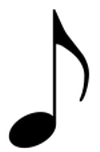 | A note that lasts for half a beat. |
| Sixteenth Note | 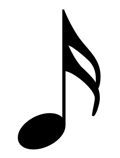 | A note that lasts for quarter of a beat. |
As I’ve mentioned in previous lessons, the meaning of each note value will change depending on the time signature. (The definitions I’ve written in the table are assuming that the time signature has 4 as the bottom number).
One interesting thing to notice from the table, is that all the notes values are exactly half the length of the one immediate above it. In other words…
- A half note is half the length of a whole note.
- A quarter note is half the length of a half note.
- An eighth note is half the length of a quarter note.
- A sixteenth note is half the length of an eighth note.
The great news is that this relationship between the note values never changes, even if the time signature changes.
Introducing Eighth Note Triplets
Before we look at eighth note triplets, let’s quickly look at some eighth notes. Please check out the musical example below…

As you can see, this example shows a bar of eighth notes with the beats written below the music. Because each eighth note lasts for half a beat, then this means we are playing two evenly spaced notes per beat.
Let’s now see what a bar of eighth note triplets would look like…
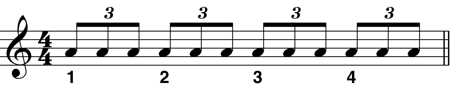
Notice how the symbol for eighth note triplets look very similar to normal eighth notes. But, as you probably can see, there are these major differences…
- There are twelve notes being played in the bar.
- The notes are grouped in three.
- There is the number 3 written above each group of notes.
- There are now three notes being played per beat.
What this all means is that with eighth note triplets you have to play three evenly spaced notes per beat. And if we were to compare the eighth note triplet to a whole note, we would come up with this rule…
Eighth Note Triplet Timing Exercise
Now that you know what eighth note triplets are, it’s very important to learn how to play them. To help you do this, we’ll be looking at this exercise…
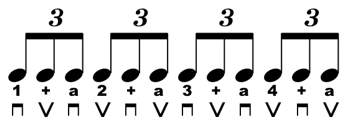
To help you get the timing right, I recommend (at least initially) using the counting that I’ve written underneath the exercise. You’ll need to count out aloud and say: “One, An, Duh, Two, An, Duh, Three, An, Duh, Four, An, Duh”.
To practice this exercise, these are the steps that you need to follow…
- Choose any note on your guitar.
- Turn on your metronome and set it to 60 bpm.
- Using alternate picking, play the note you chose in Step 1. This can be a little tricky, as sometimes you’ll need to do an upstroke when your metronome clicks.
- Repeatedly play the note using eighth note triplet timing for at least a few minutes.
Like I’ve mentioned in earlier lessons, I think it’s a great idea to tap your foot to the metronome click when you do timing exercises.
Eighth Note Triplet Chord Progression
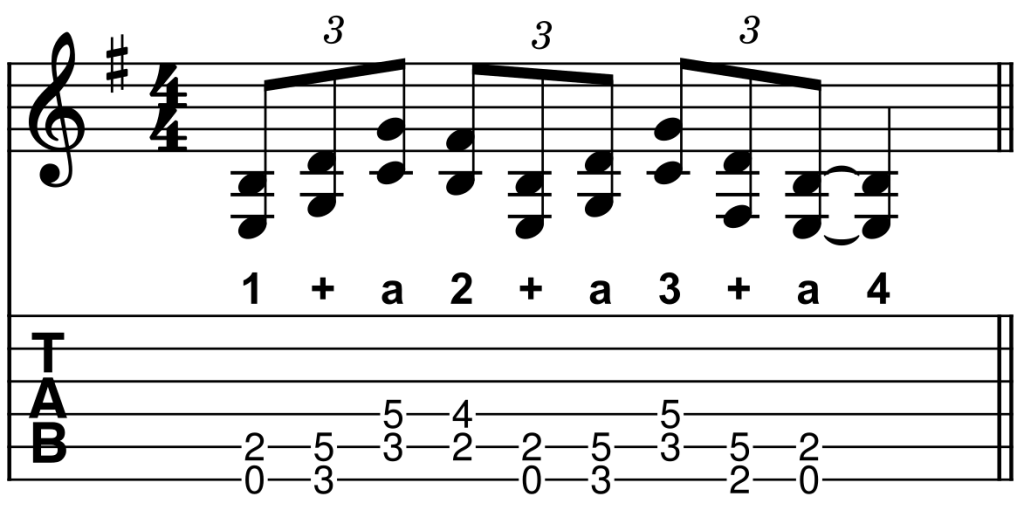
Here’s out trusty chord progression, but this time around we’re going to play it using mainly eighth note triplets…
A Few Last Words
Since we started our exploration of rhythm, we’ve covered six of the most common note values. So it would be prudent to make sure you’ve mastered all the timing exercises and chord progressions that we’ve covered to date. Doing this will help you to develop a solid rhythmic foundation, which will make more advanced rhythms much easier to tackle.
Have fun!
Return To: Guitar Music Theory Lessons